Communicating the Complex: Three Stories from Costa Rica, Ecuador, and Suriname

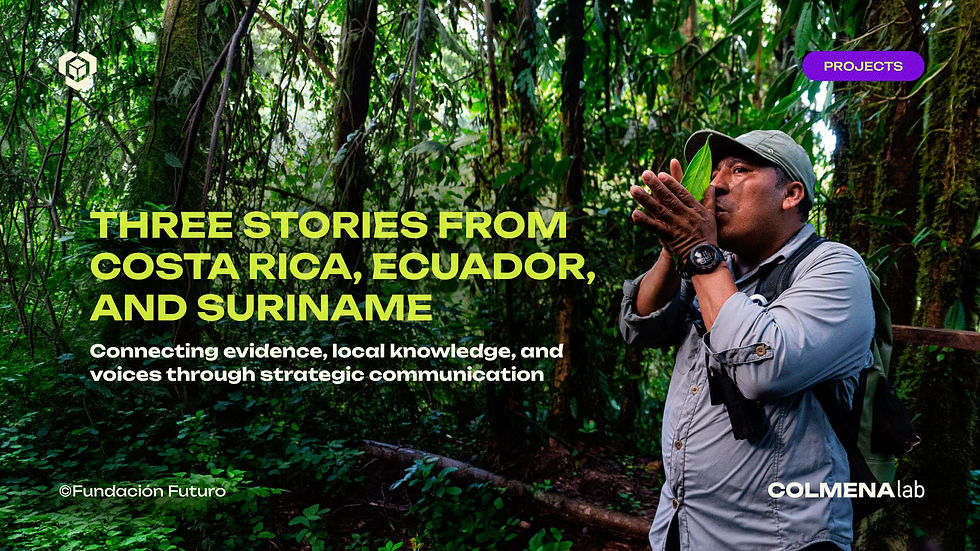
How can strategic communication transform evidence, local knowledge, and diverse voices into narratives capable of reaching new audiences and opening up spaces for advocacy?
Many of the stories that transform global conversations begin at the local level—in an Indigenous, local, or Afro-descendant community, a forest, a field study, an organization, or an assembly. Communication allows these realities to scale up by turning experiences into narratives, research into journalistic stories, voices into videos, and local actions into stories capable of opening up new possibilities.
The impact of strategic communication and advocacy
At Colmena Lab, we work at the intersection of strategic communication, science, innovation, and advocacy. In recent months, that connection took us to Costa Rica, Ecuador, and Suriname. We traveled through forests and communities; we spoke with scientists, park rangers, Indigenous leaders, local stakeholders, and civil society organizations. Each experience posed a different question: how to convey the connectivity of a forest that spans borders, how to bring a scientific discovery from Mashpi-Tayra to new audiences, and how to support a regional agenda for the rights of Indigenous Peoples in Isolation and Initial Contact.
The contexts, cultures, voices, and themes were diverse. In each place, we had to listen, understand their codes, recognize who could tell the story, and find the appropriate formats and narratives to bring those realities to new audiences without losing the context that gives them meaning.
In Ecuador’s Andean Chocó, we encountered biodiversity that is only just beginning to reveal itself under the microscope. In La Amistad International Park, we saw how a binational forest connects ecosystems, communities, and conservation efforts. In Suriname, we worked alongside 23 organizations and their partners to raise awareness of the rights of South America’s last Indigenous Peoples in Isolation.
A Forest That Unites Two Countries: La Amistad International Park

La Amistad International Park (PILA) is a binational protected area spanning Costa Rica and Panama and a UNESCO World Heritage Site. The forest unites two countries and entails a shared responsibility for conservation, supported by joint efforts in management, monitoring, and protection.
PILA is part of the Regional Biodiversity Program Linking the Central American Landscape, an IUCN initiative that seeks to strengthen connectivity across five priority landscapes in the region. Within this framework, IUCN challenged us to document the actions carried out in PILA and show how different stakeholders contribute to conserving this shared landscape.
We traveled through the South Pacific sector of Costa Rica’s PILA. Amid forests, mountains, wetlands, and pristine areas intertwined with the territories of Indigenous Peoples, we created an audiovisual narrative alongside those who know and sustain these landscapes. We documented the work of the Altamira Biological Station, the Pittier checkpoint, and farmers in the Altamira area, and spoke with park rangers, technicians, and farmers to understand how agroecological practices on small plots promote connectivity between conservation areas. Throughout this journey, we captured the voices of those who support conservation efforts and, drawing on their own experiences, shed light on the relationship between local practices and the connectivity of this binational landscape.
The process involved understanding a complex scientific topic, defining a work roadmap, and developing an appropriate approach to build an audiovisual narrative based on the experiences and knowledge of the various stakeholders. Thus, their voices were woven into a story about ecological connectivity, conservation, and binational collaboration.
On the farms in Altamira, that connection was expressed through everyday decisions:

“We create spaces for life to flow. A monkey can travel through the farm and find the tree it needs to feed. The jaguar is in these mountains, and we can show that what it eats lives on our farms.” Yendry Suárez, representative of the La Amistad Producers’ Association.
The experience demonstrated how agricultural practices are part of a larger ecological network and how the knowledge of those who work the farms provided insight into the landscape’s connectivity on an everyday scale.
The audiovisual narrative connected these experiences with the program’s technical evidence and with the binational collaboration model, showing how a single landscape can unite countries, institutions, and communities around conservation.
The small reveals the extraordinary: Biodiversity in Mashpi-Tayra

The Mashpi-Tayra Reserve, located in Ecuador’s Andean Chocó, is a place where conservation, research, and outreach coexist within the same landscape. The partnership between Fundación Futuro and Mashpi Lodge supports a team of scientists and park rangers dedicated to studying and protecting the forest, transforming it into a living space of knowledge where the biodiversity of its mountains, trees, and even its leaves can be discovered by visitors from Ecuador and around the world. In this context, research conducted by Fundación Futuro, the Mashpi Lodge research team, and the National Institute of Biodiversity—as part of the Global Malaise Trap Program—revealed a dimension of biodiversity that is difficult to perceive at first glance: 7,848 flying insects new to science.

The Fundación Futuro challenged us to bring this discovery into the global conversation, and to meet that challenge, we developed a strategy for media visibility and positioning, with a roadmap that began by crafting a narrative capable of connecting scientific evidence with the landscape, Mashpi’s conservation history, and the stories of the people who make it possible for this forest to remain standing.
Based on this, we planned various initiatives with specialized media outlets, including a media trip to the reserve. We traveled from Quito to the Andean Chocó to explore Mashpi-Tayra alongside international journalists and an audiovisual production team. The journey through the cloud forests, ravines, and rivers allowed us to experience firsthand a biodiversity that reveals itself both to the naked eye and under the microscope. Access to scientific sources and meetings with those who study and protect the forest helped us understand how this discovery is part of a much broader story of research, partnerships, and conservation.

The process required us to understand and interpret complex scientific research, define a work roadmap, and design a journalistic experience capable of connecting the evidence with its key figures and with the reserve’s conservation model. Audiovisual production, technical curation, and a Media Room stocked with data, high-resolution images, and primary sources supported the journalists’ work and opened up new possibilities for coverage.
Thus, we developed different narrative angles for the discovery: the biodiversity that is difficult to perceive, the research that makes it possible to understand it, the people who dedicate their work to studying it, and the conservation model that makes these discoveries possible. This strategy succeeded in sparking the interest of specialized journalists and bringing the story of Mashpi to new audiences.
The experience demonstrated that a scientific discovery can reach a broader audience when communication aligns with the narrative, the media, and the necessary conditions to bring it to new audiences.

Who Defends Indigenous Peoples in Isolation and Initial Contact? An Answer from Suriname
Suriname was an especially significant place to bring together the 23 organizations that make up the International Working Group for the Protection of Indigenous Peoples in Isolation and Initial Contact (GTI PIACI). It is the only country in South America where Indigenous Peoples lack legal recognition. For organizations working for their rights, this reality makes it urgent to strengthen exchange, gather information, and build a collective response to threats that also jeopardize Indigenous Peoples in Isolation and Initial Contact.

The Assembly brought together organizations from eight countries across the Amazon and the Gran Chaco to share experiences, identify common challenges, and strengthen protection actions. The realities were diverse, with different political contexts, ecosystems, peoples, and threats, but the common goal was to strengthen the collective capacity to defend the rights of PIACI.
GTI PIACI presented us with the challenge of accompanying this process through communication and developing a roadmap capable of articulating the different voices without losing their unique characteristics. In Paramaribo, we partnered with Indigenous leaders, local organizations, and allies to capture their experiences, priorities, and proposals.
Colmena Lab also supported the policy advocacy spaces generated during the Assembly. We documented the dialogue with representatives of Suriname's Executive branch and Legislative Assembly and created content to amplify the work of the organizations beyond the gathering. The goal was to heighten the visibility of an agenda facing concrete threats, such as unwanted contact, the advance of extractive activities, and health risks for highly vulnerable peoples.

In that context, Sirito Yana Aloema, Indigenous leader of the Kari’ña people and representative of Trijana Foundation, summarized it like this:
“They will not speak for themselves. We need to speak for them.”
The experience demonstrated how Colmena Lab's work strengthens advocacy capacity in the territory: we collaborated in coordinating the 21 organizations of GTI PIACI, structured their demands into effective narratives, and through the participatory design of a communication roadmap, consolidated these alliances to safeguard the protection of Indigenous Peoples in Isolation and Initial Contact.

Three places, three contexts, and three ways of working with communication.
In each case, we adapted the strategy to the people, issues, and circumstances to transform knowledge, experiences, and voices into narratives capable of changing global conversations without losing the context that gives them meaning. For us, the true value of strategic communication lies in building the connections that allow local realities to reach global audiences, turning evidence into stories, and using them to open spaces for advocacy.


Comments